

2009 T-45 HSRIP Flight Test Team
T-45 HSRIP FLIGHT TEST TEAM
Nomination for the 2009
SFTE “James S. McDonnell” Award
T-45 Hot Section Reliability Improvement Program (HSRIP) Overview
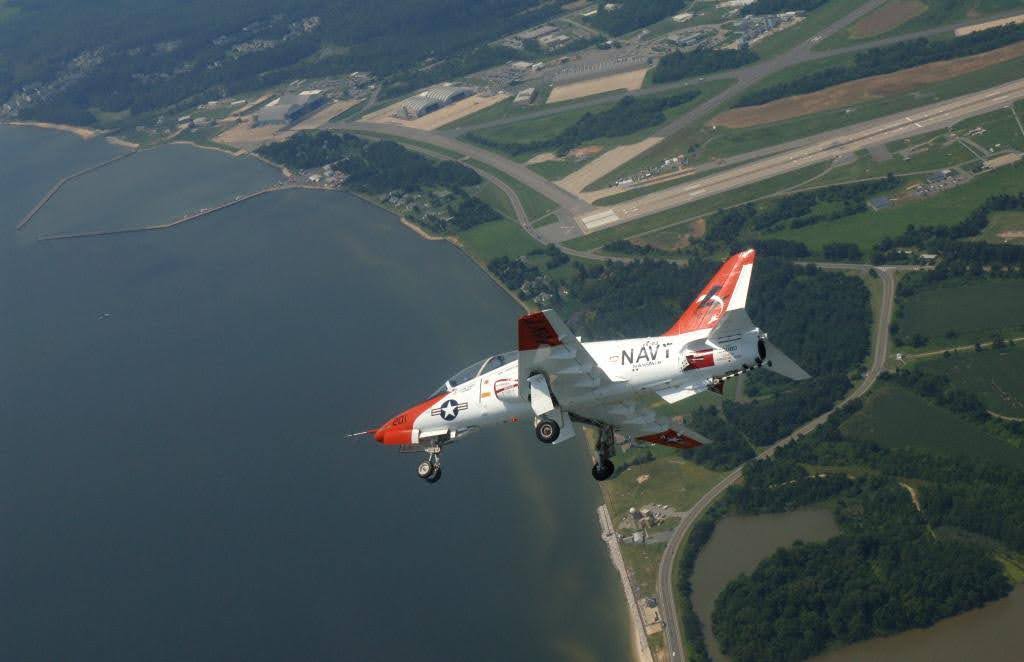
The Boeing T-45 is the U.S. Navy's advanced jet trainer, providing initial carrier qualification of Naval Aviators. It is a subsonic, single-engine, carrier-capable derivative of the British Aerospace Hawk. Since its fleet introduction, the Navy's training command has experienced numerous engine surges, 90% of which are classified as “pop stalls”, which cleared with no pilot action required. The remaining 10% were classified as “locked surges”, which required engine shutdown to prevent engine over-temperature. Standard training command procedure is to immediately return to base following any engine surge incident. The surges occur during air combat maneuvering (ACM) training or approach-turn stall recovery training. The Navy is considering a derivative of the Rolls-Royce MK 951 Adour, which was flight tested in South African Air Force Hawk aircraft, as a replacement for the T-45's current Adour engine, the F405-RR-401. The Navy's program to incorporate the engine into the T-45 is called the Hot Section Reliability Improvement Program (HSRIP). The HSRIP engine, designated the F405-RR- 402, provides a Full Authority Digital Engine Control (FADEC), an improved backup Manual Fuel Control (MFC) system, and a new hot section which should provide longer life. Operationally, the FADEC provides automatic surge detection and recovery logic, an improved airstart envelope, and the potential to optimize the engine's transient schedules for glideslope handling qualities. Not a fully form, fit, and function replacement for the production F405-RR-401 engine, the HSRIP engine integration required minor airframe modifications to facilitate installation of either the -401 or -402 HSRIP engine. The Navy's Program Managers for the T-45 (PMA-273) tasked Naval Air System Command (NAVAIR) flight test to perform a technical evaluation of the HSRIP engine installed in the T-45C aircraft.
Team Personnel
The test team was composed of NAVAIR, Boeing, Rolls Royce, Wyle engineers and Navy, Marine Corp, and Boeing test pilots. Various disciplines representing Flying Qualities, Propulsion, Loads and Dynamics, Carrier Suitability, and a senior test conductor were the core of the test team.
Accomplishments
Approximately 140 flight and ground test were completed with the following results:
- Performed an initial airworthiness evaluation, which, during four flights, satisfied standard functional check flight requirements, demonstrated basic engine operability, and demonstrated heart-of-the-envelope airstart capability.
- Demonstrated airstart capability consistent with current Navy Flight Manual (NATOPS) envelope and defined expanded airstart envelope capability.
- Demonstrated satisfactory engine operation within the current NATOPS envelope, including surge free operation comparable to the current F405-RR- 401 engine.
- Demonstrated automatic surge detection and recovery capability.
- Demonstrated sufficient flameout margin.
- Demonstrated satisfactory aircraft carrier suitability (CVS), including approach handling qualities, surge free operation during steam ingestion tests with a degraded shore-based steam catapult, and satisfactory results during catapult and arrested landing load demonstration points.
- Defined handling qualities differences attributable to the HSRIP engine.
- Collected sufficient data to validate the T-45C aero-performance model with the HSRIP engine installed.
- Performed back-to-back handling qualities evaluation of the proposed engine transient schedules (FADEC trim files) in order to select the optimum configuration for glideslope handling qualities.
- Demonstrated in-flight conversions between primary and backup fuel control modes and engine operation during moderate engine handling in backup fuel control mode.
- Developed recommended changes to NATOPS flight manual for normal and emergency procedures.
As a result of the successes achieved during this program, student Naval aviator safety will be improved, and a more efficient (less down time) and cost-effective (increased life) engine will soon be available to the Fleet.
Summary of Tests
- First Engine Start: 20 November 2007
- First Ground Test Run: 10 December 2007
- First Test Flight: 18 December 2007
- Total Flights as of 9 June 2009: 121
- Tests remaining: CVS testing for deficiency correction, final trim file evaluation, and aircraft carrier trip)
- Engine operating time: 223 hrs
- Airstarts: 54
- Engine Out Time: 42.7 minutes
- Locked-in Surges: 15
- Pop Surges: 15
Unique Operational Risk Management
The HSRIP test program maximized lessons learned from previous T-45 engine tests and South African Hawk tests. The test program was aggressive when considered necessary and applied buildup when required to minimize risk during the high-risk test program. One of the most significant accomplishments of the test team was the development of simulated and actual engine-out landing procedures which mitigated the risk of performing single engine airstart and engine compatibility tests over water with only field runways available for landing. Typically, single-engine airstart and surge testing is performed over the dry lakebeds at Edwards Air Force Base. In making the decision to perform the testing at NAS Patuxent River, the team considered the characteristics of the T-45, the maturity of the HSRIP engine, and lessons learned from over 20 years of T-45 flight test. Methods developed during previous engine testing were used as the basis for the new engine out landing procedures. In the event of an engine flameout and failed re- light attempts, it was essential that the test aircraft be within glide distance to the field in order to execute either a high-key approach or a straight in approach (wind and altitude dependent). Prior to each high risk test point the test aircraft pilot would relay the winds aloft at test altitude to the test team. Using a table that denoted wind velocity and heading (headwind, tailwind, crosswind) as well as minimum altitude required and distance back to the airfield, a dedicated “glide monitor” determined the maximum allowable distance from the field before the maneuver commenced. While engine-out, the glide monitor radioed minimum altitude calls based upon distance calls from the chase aircraft. All high risk test points were begun with the aircraft no less than a 90 degree turn back to the field to ensure that the test aircraft could successfully execute an approach with engine out if required. Prior coordination with the airfield tower and test area controllers mitigated the impact to other test programs, allowing normal flight operations to continue at the field.
These procedures were briefed at a 2008 SETP conference in Melbourne, FL, and were well-received by several test organizations that did not have the benefit of a dry lakebed for their engine-out testing.
Other Considerations
Junior engineers, as part of the HSRIP team, were given first-hand experience in the conduct of high-risk flight test. Two junior engineers qualified as safety-of-flight glide monitors and two contractor and two government engineers were trained as test conductors. For training purposes, non-HSRIP propulsion flight test engineers were invited to observe the conduct of single-engine flight testing.
In working with the junior flight test engineers on the HSRIP program, it was apparent to the team that new engineers would benefit from a training program that provided the basic aircraft and flight test on-the-job type knowledge that a new engineer learns during the first two years. Recognizing this, the team is working with senior engineers and test pilots who have volunteered to develop a series of weekly training lectures. To date, three lectures have been given with additional lectures planned. Lectures cover topics such as Aircraft Basics, Pitot Statics, Test Execution, Mission Planning, Test Techniques, Airspace Rules, NATOPS Flight Manual, and Fleet Operations. The training will culminate in a simulation exercise followed by a telemetered T-45 flights.
Reflecting the team's accomplishments, the lead engineer was selected as the NAVAIR Test Wing Atlantic Flight Test Engineer of the Year for 2007 and the project officer was selected as the NAVAIR Test Wing Atlantic Test Pilot of the Year for 2008.