2008 E-2D Advanced Hawkeye Test Team
E-2D “Advanced Hawkeye” FLIGHT TEST TEAM
Nomination for The 2008
SFTE “James S. McDonnell” Award
E-2D Overview
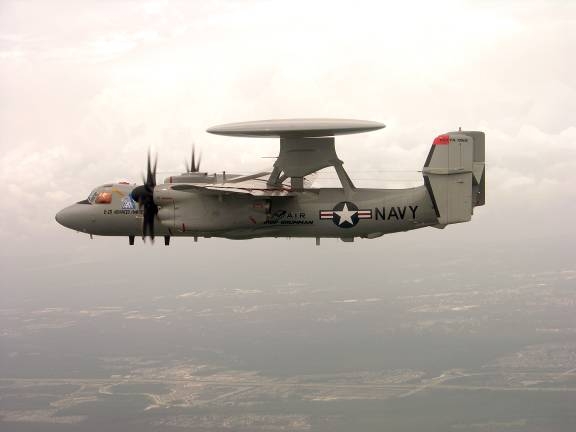
The E-2D Advanced Hawkeye (AHE) is a development effort intended to fulfill U.S. Navy requirements for Airborne Early Warning and Command and Control directed against projected threats in the 21st century. The AHE development effort's primary goal is the improvement of E-2C Hawkeye 2000 (HE2K) performance in two key areas. The first is to enhance the ability to operate in the littoral environment, defined as operations within line of sight of a major coastline. The system must account for increased active and passive signal density, over land as well as over sea detection, and improved over land tracking. The second is to provide the ability to perform theater missile detection, tracking, and reporting in support of Theater Air and Missile Defense (TAMD). To enable these performance improvements a broad range of E-2C HE2K systems will be upgraded, replaced, or have additional functionality. The major systems affected are the radar, Identification Friend or Foe (IFF), mission computer and displays, electrical generators, communications including data links, engine control, and cockpit display changes to allow a fourth operator to occupy either the pilot or copilot seat and have access to the tactical picture. Two prototype aircraft are being used for test efforts. The first aircraft, AA-1, is primarily used by the Air Vehicle team to test and validate the aeromechanics. AA-1 also serves as a Mission Systems platform when needed; however, the second aircraft (AA-2) is dedicated to the Mission Systems team. As of 25-August- 2008, the E-2D Integrated Test Team (ITT) has executed over 120 ground test days and flown over 140 flights between the two E-2D aircraft for an accumulation of 425 E-2D flight hours with no mishaps or incidences.
Team Composition
The individuals that comprise this team brought diverse experiences and unique perspectives that have fostered innovation within the team. The test aircrew, comprised of Naval Air Systems Command (NAVAIR) and Northrop-Grumman Corporation (NGC) test pilots, flight officers, and weapon system operators, bring a wealth of experience and training that range from USN Test Pilot School graduates with recent fleet experience to NGC test aircrew with years of E-2/C-2 flight test background. Engineering diversity includes flight test engineers from NAVAIR, NGC, Hamilton Sundstrand, Rolls Royce, and Lockheed Martin. These engineers and technologists not only have backgrounds in E-2 and C-2 platforms, but also bring backgrounds from programs that include: KC-130, E-6, F-14, and commercial platforms. While taking advantage of these diverse backgrounds, the team is lead by personnel with extensive E-2C test backgrounds from within NAVAIR and NGC. This combination of talent and leadership has allowed the team to operate at the highest levels.
Accomplishments (from April 06 – present)
Starting in mid 2006 to present, the team focused on detailed test planning in order to clearly define the most effective and efficient methods of verifying aircraft system performance. In April 2007, the E-2D ITT initiated ground tests of the first test aircraft, AA1. This signified the beginning of the developmental test phase of the E-2D program. The team worked seamlessly in planning future tests while executing ground tests to prepare for the first flight of AA-1, affectionately name “Delta 1”. From April through August of 2007, the team completed over 150 test events that were required to demonstrate that the aircraft was safe for first flight. These events were completed on time and within budget to support the first flight of the aircraft on August 3, 2007. This achievement was possible due to team work and the ability of the ITT to overcome challenges that ranged from the complexities of technology development to the personal stresses associated with being relocated under short notice. Through teamwork, cooperation, and perseverance, the team was able to accomplish their first flight goal. In developing the test strategy for the program, the team leveraged on lessons learned from recent test programs such as the E-2C and C-2A NP2000 Re-propeller programs and the NC-130H Radar Development program. These programs produced technologies and test methods that greatly reduced technical risk while at the same time, increased safety of test through unique methods of test in areas including radar performance, propulsion system integration, and flight station modernization. The technical challenges associated with the development of the E-2D have included: integration of a Full Authority Digital Engine Control, test and development of a higher power radar system, and integration of new mission computers and software. These technical issues as well as others were at the forefront in evaluating the maturity of the E-2D with respect to airworthiness, safety of flight, and continued envelop expansion. The team, through research, development, test, and analysis, identified and addressed each risk item and mitigated the applicable hazards.
Program Firsts:
10 Apr 2007 – Ground testing commences with the first prototype, AA-1
3 Aug 2007 – First flight of the E-2D Advance Hawkeye, AA-1
29 Nov 2007 – First flight of the second E-2D aircraft, AA-2
14 Dec 2007 – First Mission Systems flight
20 Mar 2008 – First night flight
21 Mar 2008 – First radar-controlled target flight
23 Jul 2008 – IMC Flight approved